

Your step-by-step guide to selling property in Ireland
- bryanlittle1
- Mar 29
- 7 min read

Selling your home in Dublin or Kildare is one of the biggest financial decisions you’ll ever make, and it’s completely normal to feel uncertain about where to begin. Many homeowners find themselves overwhelmed by the sheer number of steps involved, from gathering paperwork to negotiating offers and navigating legal requirements. The good news is that the process becomes far more manageable when you understand each stage clearly. The selling process in Ireland typically takes 3 to 7 months from preparation to closing, so knowing what to expect at every point helps you plan with confidence and avoid costly surprises.
Table of Contents
Key Takeaways
Point | Details |
Plan ahead | Start gathering essential documents early to speed up your sale in Ireland. |
Understand the steps | Knowing each phase of the sales journey helps you avoid delays and stress. |
Get accurate valuation | A fair, expert-led property valuation leads to successful and timely sales. |
Avoid common errors | Double-check all paperwork and pricing to prevent stalled or failed sales. |
Expert support matters | Working with a knowledgeable agent simplifies the process from start to finish. |
What you need before starting the selling process
With the big picture and timeline in mind, let’s make sure you’re ready with everything you need before your home goes to market. Good preparation is not just about tidying up. It’s about having the right documents, the right mindset, and the right professional support from day one.
Preparation sets the foundation for a smooth sale and directly impacts how quickly you move to market. Missing a single document can delay your sale by weeks, so it pays to get organised early.
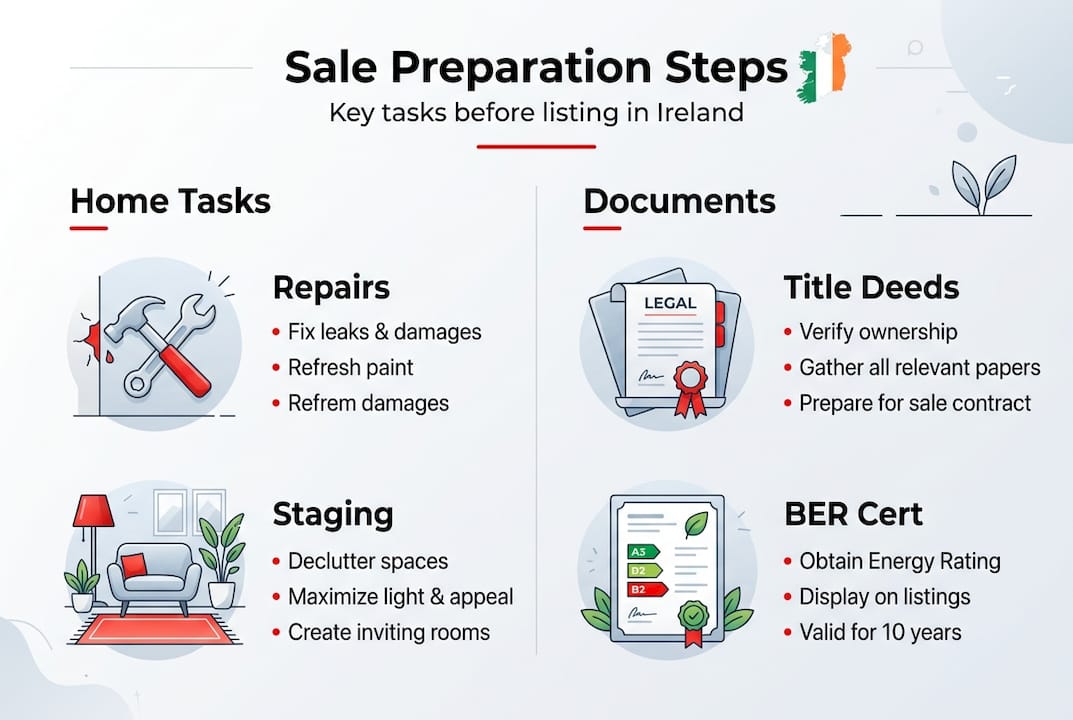
Here are the key documents you’ll need to gather:
BER certificate (Building Energy Rating): legally required before listing
Title deeds: proof of ownership, held by your solicitor or mortgage lender
NPPR certificate: confirms payment of the Non-Principal Private Residence charge if applicable
Local Property Tax (LPT) receipts: evidence of compliance
Planning permission documents: for any extensions or alterations
Management company details: if your property is in an apartment or managed estate
Beyond paperwork, assess your property honestly. Small repairs, a fresh coat of paint, and thoughtful staging can meaningfully increase buyer interest. Read our guide on preparing your home for sale for practical tips on presentation.
You’ll also want an accurate valuation before you set an asking price. Understanding property valuation essentials helps you enter the market with realistic expectations and a competitive edge.
Preparation task | Why it matters | Typical timeframe |
Gather legal documents | Prevents delays at contract stage | 2 to 4 weeks |
BER assessment | Legal requirement for listing | 1 to 2 weeks |
Property repairs and staging | Increases buyer appeal and offers | 2 to 6 weeks |
Initial valuation | Sets realistic asking price | 1 week |
Pro Tip: Start collecting your paperwork at least a month before you plan to list. Solicitors and BER assessors can be busy, and early preparation keeps your timeline on track.
Step-by-step process of selling your property in Ireland
Now you’re prepared, let’s take a practical walk through each phase of the sales process and what to expect at every step.
The selling process ranges from 3 to 7 months, with 4 to 8 weeks typically covering pre-market activity through to sale agreed, 8 to 12 weeks for the legal process, and a further 2 to 4 weeks to close. Here’s how each stage unfolds:
Initial valuation: Invite two or three local estate agents to value your property. Compare their assessments and ask each one to explain their reasoning. A well-informed valuation sets the right tone for everything that follows.
Appointing an estate agent: Choose an agent with strong local knowledge of Dublin or Kildare. Review their marketing approach, fee structure, and communication style. Our estate agent tips can help you ask the right questions.
Marketing and viewings: Your agent will list your property on major portals, use professional photography, and arrange viewings. Open houses can generate competitive interest quickly.
Receiving and negotiating offers: Don’t accept the first offer without considering the buyer’s position. A cash buyer with no chain is often more valuable than a slightly higher offer from someone with a complex mortgage situation.
Sale agreed to contract exchange: Once you accept an offer, your solicitor and the buyer’s solicitor exchange contracts. This legal stage is where how estate agents help becomes especially clear, as they keep communication flowing between all parties.
Closing the sale: Contracts are signed, funds are transferred, and keys are handed over. Congratulations, your sale is complete.
Stage | Typical duration |
Pre-market preparation | 2 to 6 weeks |
Marketing to sale agreed | 4 to 8 weeks |
Legal process | 8 to 12 weeks |
Closing | 2 to 4 weeks |
If you’re selling in Kildare, local market conditions and buyer demand can vary by area, so working with an agent who knows the region is particularly valuable.
Pro Tip: Keep regular contact with both your solicitor and your estate agent throughout the legal stage. A quick phone call each week can prevent small issues from becoming costly hold-ups.
Understanding valuations and the Irish property market
With a step-by-step understanding in place, it’s vital to know how your property’s value is determined and what local factors will influence your final sale price.
A property valuation is a professional assessment of what your home is worth in the current market. Estate agents provide market appraisals based on comparable sales, while chartered valuers offer formal reports often required by lenders. Both serve different purposes, and it’s worth understanding which you need at each stage.
Accurate valuation is critical in achieving a fair sale price and a realistic timeline. Overpricing is one of the most common mistakes sellers make, and it almost always results in a longer time on the market and a lower final price.
Factors that influence your property’s value include:
Location: Proximity to schools, transport links, and amenities in Dublin and Kildare carries significant weight
Condition: Well-maintained homes with modern kitchens and bathrooms consistently attract stronger offers
Market trends: Supply and demand in your specific area at the time of listing
Property size and type: Square footage, number of bedrooms, and garden space all matter
Recent comparable sales: What similar homes nearby have sold for in the past three to six months
“Sellers who price their property accurately from the outset spend less time on the market and achieve closer to their asking price. Overpricing creates doubt in buyers’ minds and can stigmatise a listing.”
Understanding local property trends in Dublin and Kildare gives you a real advantage when setting your asking price. You can also explore why listing online for valuation purposes helps sellers benchmark their property against the live market.
Valuation factor | Impact on sale price |
Prime location | High positive impact |
Poor condition | Significant negative impact |
Accurate pricing | Faster sale, stronger offers |
Overpricing | Longer time on market, price reductions |
Mistakes to avoid and troubleshooting common problems
Knowing valuation and market trends helps you position your property well, but avoiding missteps is just as crucial for a smooth, successful sale.
Delays often occur when documents aren’t prepared in advance or when expectations around pricing aren’t managed realistically. These are the most common issues we see, and they’re all avoidable.
The most frequent causes of delay and failed sales include:
Missing or incomplete documents: A missing NPPR certificate or outdated BER can stall the legal process entirely
Poor property presentation: Cluttered or poorly maintained homes receive fewer viewings and lower offers
Overpricing: Properties priced above market value sit unsold and often require price reductions that undermine buyer confidence
Buyer financing falling through: Always ask your agent to verify a buyer’s mortgage approval before accepting an offer
Legal complications: Boundary disputes, planning irregularities, or title issues can delay or collapse a sale
If your sale stalls after going sale agreed, don’t panic. Work with your solicitor to identify the specific issue, whether it’s a legal query, a valuation dispute from the buyer’s lender, or a documentation gap. Most problems have solutions when addressed promptly.
“A sale that falls through is rarely the end of the road. With the right agent and solicitor, most issues can be resolved or the property can be relisted quickly with lessons learned.”
Stay informed by following selling trends and insights relevant to the Dublin and Kildare markets. Being aware of what’s happening locally helps you make better decisions at every stage.
Pro Tip: Before you publicly list your property, confirm that every document is in order and your solicitor has everything they need. This single step can save you weeks of frustration later.
How RE/MAX Partners can support your sale
Having expert knowledge on hand makes the process far less daunting, and that’s exactly what we’re here for. At RE/MAX Partners, we work with homeowners across Dublin and Kildare every day, guiding them through every stage of the selling process with clarity and care.

We offer accurate property valuations, targeted marketing using professional photography, virtual tours, and drone imagery, and hands-on support from listing through to closing. Whether you’re selling a family home in Leixlip or an apartment in Dublin city, our team brings local expertise and genuine commitment to every sale. You can request a property valuation at a time that suits you, explore our full property services, or simply get in touch with our local experts in Leixlip and Celbridge to start the conversation. We’re ready to help you sell with confidence.
Frequently asked questions
How long does the selling process in Ireland take from start to finish?
Selling a property in Ireland typically takes 3 to 7 months from preparation through to closing, depending on market conditions and how quickly legal steps are completed.
What documents do I need before listing my Irish home for sale?
You’ll need your BER certificate, title deeds, NPPR certificate, Local Property Tax receipts, and any planning permission documents. Preparation sets the foundation for a smooth and timely sale.
What is the role of an estate agent when selling in Ireland?
Estate agents guide sellers through valuation, marketing, viewings, offer negotiation, and coordination with solicitors throughout the legal process.
What if my property sale is delayed?
Check that all documents are complete and that your asking price reflects current market value. Most delays are resolved quickly once the root cause is identified and addressed.
Recommended


Comments