

Why Buy Near Dublin? 15% Lower Prices & 40-Min Commute
- kbyrne
- Mar 1
- 11 min read

Dublin’s housing market challenges buyers with average prices around €500,000 and fierce competition for limited inventory. Supply shortages force many to bid above asking, making city ownership increasingly difficult. This reality pushes homebuyers and investors to explore nearby counties, where affordability meets accessibility. County Kildare emerges as a strategic alternative, offering vibrant communities, quality amenities, and transport links that keep Dublin within reach while delivering genuine savings and lifestyle balance.
Table of Contents
Key Takeaways
Point | Details |
Affordability Advantage | Kildare homes average €426,500, roughly 15% cheaper than Dublin properties with lower taxes. |
Commute Convenience | Recent rail upgrades reduce travel times to 30-40 minutes, making daily commutes practical. |
Community Quality | Towns like Leixlip and Celbridge provide excellent schools, parks, and local services. |
Policy Support | Budget 2026 VAT cuts and regeneration incentives improve housing supply near Dublin. |
Investment Value | Lower purchase prices and strong rental demand deliver higher yields than city properties. |
The Dublin Housing Market Challenge
Dublin’s housing market presents significant barriers for buyers in 2026. Average property prices hover around €500,000, driven by persistent supply shortages that restrict available inventory. Competition remains intense, with properties often selling 9-10% above asking price and typical market times between 40 and 55 days.
Limited stock creates bidding wars that push even modest homes beyond budget for many first-time buyers and growing families. Developers struggle to keep pace with demand, and planning delays compound the shortage. These conditions force buyers to reconsider their geographic priorities, weighing city convenience against financial strain.
Commuter counties like Kildare attract attention as viable alternatives. Buyers discover they can secure larger homes with gardens and better amenities for substantially less money. The Dublin and Kildare housing market overview shows this trend accelerating throughout 2026.
“Supply constraints and strong buyer competition in Dublin create a market where affordability becomes the primary decision factor, not preference.”
This dynamic reshapes how people approach homeownership near the capital. Proximity matters, but value and quality of life matter more. Exploring areas within commuting distance offers a balanced solution that addresses both financial and lifestyle goals without sacrificing career opportunities in Dublin.
Comparing Housing Affordability: Dublin vs. County Kildare
Price differences between Dublin and Kildare reveal substantial savings for buyers. Kildare homes average about €426,500, delivering approximately 15% lower costs than comparable Dublin properties. This gap translates to real money that buyers can allocate toward renovations, furnishings, or savings.
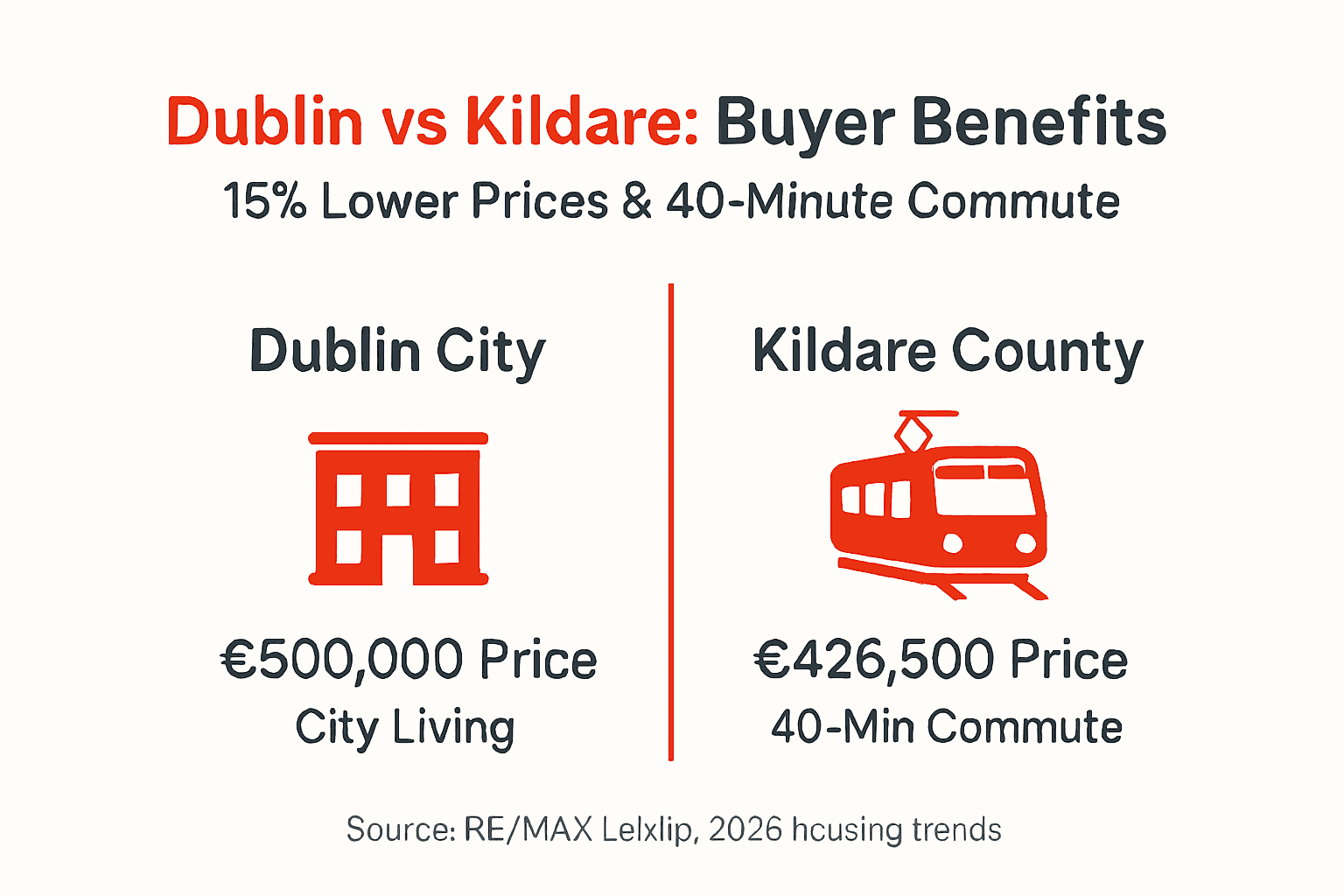
Beyond purchase price, ongoing ownership costs favour Kildare. Property taxes remain lower in commuter counties, reducing annual expenses. Maintenance and insurance costs often track lower as well, particularly for newer builds common in developing Kildare estates. These factors combine to improve overall affordability significantly.
Rental yields present another advantage for investors. Lower purchase prices paired with strong tenant demand from Dublin workers generate higher percentage returns. Kildare properties often achieve 5-6% gross yields compared to 3-4% in Dublin city, making them attractive for portfolio growth.
Metric | Dublin | Kildare | Advantage |
Average Price | €500,000 | €426,500 | 15% lower |
Property Tax (annual) | Higher | Lower | Reduced costs |
Gross Rental Yield | 3-4% | 5-6% | Better returns |
Days on Market | 40-55 | 45-60 | Similar liquidity |
Total cost of ownership extends beyond the deposit. Buyers should calculate mortgage interest over 20-30 years, factoring in current rates around 3.5-4%. Stamp duty and legal fees also impact the final outlay, though these scale with purchase price.
Pro Tip: Calculate your monthly mortgage payment for both Dublin and Kildare properties at current interest rates. Include property tax, insurance, and estimated maintenance to see the true monthly cost difference.
Smart buyers compare apples to apples when evaluating value. A three-bedroom semi-detached home in Leixlip offers similar commute times to many Dublin suburbs but costs significantly less. Understanding these Kildare housing market trends helps buyers make informed decisions that align with long-term financial goals.
Transport Connectivity: How Improved Infrastructure Enables Commuting
Transport infrastructure upgrades have transformed commuting from Kildare to Dublin. Recent rail and road improvements reduce commute times to 30-40 minutes, making daily travel practical for professionals. Regular train services from towns like Leixlip and Celbridge connect to Dublin’s business districts efficiently.

Rail frequency has increased significantly, with peak-hour trains running every 15-20 minutes. This reliability eliminates the uncertainty that once deterred buyers from commuter counties. Modern rolling stock provides comfortable seating and WiFi, allowing productive use of travel time for emails or planning.
Road networks also benefit from ongoing investment. The M4 motorway provides quick access to Dublin’s western suburbs, while the M7 serves southern routes. Bus services complement rail options, offering flexibility for various work schedules and locations. These transport links in Kildare rival many inner-suburb connections.
Key transport features include:
Direct rail service to Dublin Connolly and Heuston stations from major Kildare towns
Peak-hour train frequency every 15-20 minutes during commuter periods
M4 and M7 motorway access providing alternative road routes
Express bus services offering additional flexibility for varied schedules
Park and ride facilities at major stations reducing last-mile challenges
“Modern transport infrastructure has erased the traditional disadvantage of living outside Dublin, creating genuine alternatives for homebuyers seeking value.”
Commute time comparisons surprise many buyers. Travel from Leixlip to central Dublin often takes less time than from outer Dublin suburbs like Swords or Tallaght during peak hours. Traffic congestion affects city routes more severely, while trains maintain consistent schedules. Understanding these commuting improvements to Dublin changes the calculus for location decisions.
Accessibility supports property values over time. As more people recognize commuting feasibility, demand in well-connected Kildare towns remains strong. This infrastructure investment signals continued growth potential, benefiting early buyers who secure properties before further price appreciation occurs.
Community and Lifestyle Advantages in Kildare Towns
Kildare towns offer quality of life that extends beyond affordability. Leixlip and Celbridge feature excellent schools, both primary and secondary, with strong academic reputations. Parents find catchment areas more manageable than oversubscribed Dublin schools, reducing stress around educational placement.
Local amenities create self-sufficient communities. Supermarkets, medical centres, sports facilities, and restaurants cluster in town centres, minimizing dependence on Dublin for daily needs. Parks and green spaces provide recreation and community gathering points, particularly valuable for families with young children.
Small-town atmosphere combines with cosmopolitan access. Regular farmers’ markets, community events, and local festivals foster neighbourly connections rarely found in urban settings. Yet Dublin’s cultural attractions, dining scene, and entertainment remain accessible for weekends and special occasions.
Community life in Kildare balances tranquility with convenience:
Well-regarded primary and secondary schools with manageable catchment areas
Multiple supermarkets, pharmacies, and medical centres within town boundaries
Sports clubs including GAA, soccer, rugby, and swimming facilities
Parks, playgrounds, and riverside walks providing outdoor recreation
Active community groups organizing events that build social connections
Professionals appreciate the separation between work and home life. Leaving Dublin after work provides psychological distance that helps maintain work-life balance. Garden space, quieter streets, and friendly neighbours contribute to reduced stress levels compared to apartment living in busy city districts.
Pro Tip: Visit Kildare towns on weekday evenings and weekends to experience the community atmosphere firsthand. Attend a local market or sports event to gauge whether the lifestyle suits your family’s needs.
Property types vary from modern estates to period homes, offering choices for different tastes and budgets. New developments often include energy-efficient designs that reduce utility costs, while older properties provide character and established gardens. This diversity allows buyers to find homes matching their specific requirements without compromise.
Government Policies and Market Trends Supporting Near-Dublin Buying
Government initiatives in 2026 actively support housing affordability in commuter counties. Budget 2026 VAT reductions on new apartments lower construction costs, encouraging developers to build in areas like Kildare. These savings pass to buyers through reduced purchase prices on new builds.
The Derelict Property Tax incentivizes owners to renovate or sell vacant properties. This policy increases available housing stock, particularly in established towns where older buildings sat empty. Urban regeneration improves streetscapes while adding quality homes to the market, supporting pricing trends in commuter counties.
Market dynamics show steady demand without the overheated price growth seen in previous years. Kildare prices rise modestly, reflecting genuine demand rather than speculation. This stability attracts both homebuyers and investors seeking predictable appreciation without bubble risk.
Policy/Trend | Impact on Dublin | Impact on Kildare |
VAT Reductions (New Apartments) | Limited effect due to high land costs | Significant savings encourage new construction |
Derelict Property Tax | Targets inner-city vacant buildings | Unlocks stock in established towns |
Price Growth Rate | 3-5% annual increase | 2-4% stable appreciation |
Supply Pipeline | Constrained by planning delays | Active development in multiple towns |
These government housing policies 2026 create structural advantages for commuter counties. Developers find it easier to secure planning permission and deliver projects on schedule outside Dublin’s congested planning system. Faster delivery times reduce holding costs, enabling competitive pricing.
Investors benefit from tax treatment favouring rental properties in high-demand areas. Mortgage interest remains tax-deductible against rental income, improving cash flow for landlords. Combined with higher yields and lower entry prices, Kildare represents a compelling investment thesis for portfolio diversification.
Market transparency has improved through better data collection and reporting. Buyers access reliable information about recent sales prices, market times, and local demand patterns. This transparency reduces information asymmetry, helping buyers negotiate fairly and avoid overpaying during emotional bidding situations.
Common Misconceptions About Buying Near Dublin
Several myths discourage buyers from exploring Kildare despite clear advantages. The first misconception involves commute difficulty. Many assume travel from commuter counties adds hours to daily routines, but train services complete the journey in under 40 minutes, often faster than cross-city commutes.
Price difference skepticism represents another barrier. Some buyers believe savings are minimal after accounting for commuting costs, but 15% lower purchase prices plus reduced property taxes create substantial lifetime savings. Fuel or train ticket costs rarely offset this advantage, particularly when comparing total ownership expenses.
Housing quality concerns persist despite evidence to the contrary. Buyers worry that cheaper properties mean inferior construction or fewer amenities. In reality, newer Kildare developments often feature better energy ratings and modern designs than older Dublin stock. Schools, healthcare, and retail infrastructure match or exceed many Dublin suburbs.
Common misconceptions debunked:
Myth: Commuting from Kildare takes over an hour each way during peak times
Reality: Direct train services reach Dublin in 30-40 minutes with reliable schedules
Myth: Price savings disappear when factoring in commuting and other hidden costs
Reality: 15% lower prices, reduced taxes, and higher rental yields create genuine financial advantages
Myth: Kildare towns lack quality schools, medical facilities, and shopping options
Reality: Established infrastructure provides comprehensive services without Dublin dependence
Pro Tip: Test your commute during typical workday hours before making a final decision. Board a morning train to experience the actual journey time and comfort level, then evaluate whether it suits your lifestyle.
Resale value concerns also surface frequently. Buyers worry that properties in commuter towns appreciate slower than Dublin homes, limiting future selling options. Historical data shows Kildare properties maintain strong liquidity, with steady demand from the next generation of buyers seeking the same affordability and lifestyle benefits.
Understanding these misconceptions about commuting helps buyers make decisions based on facts rather than outdated assumptions. Transport improvements and policy support have fundamentally changed the equation, making near-Dublin buying a smart choice rather than a compromise.
How to Make an Informed Decision: Practical Considerations for Buyers and Investors
Successful property decisions require systematic evaluation of multiple factors. Start by assessing your daily commute needs, including work location, schedule flexibility, and transportation preferences. Visit potential towns during peak hours to experience the actual journey, not just review timetables.
Financial analysis should cover total cost of ownership. Calculate mortgage payments at current rates, add property tax, insurance, and estimated maintenance costs. For investors, project rental income based on local market rates and vacancy assumptions. This comprehensive view reveals true affordability beyond advertised prices.
Community fit matters for long-term satisfaction. Research school catchments, visit local amenities, and talk to current residents about their experiences. Join online community groups to understand neighbourhood dynamics and identify any concerns before committing.
Market timing considerations include monitoring pricing trends in commuter counties and understanding seasonal patterns. Spring typically sees increased activity, while winter offers fewer competing buyers. Government policy changes in annual budgets can affect incentives and tax treatment.
Decision framework steps:
Define your maximum commute time and test actual travel from shortlisted towns during workday hours
Calculate total monthly ownership costs including mortgage, taxes, insurance, and maintenance reserves
Visit potential communities on both weekdays and weekends to assess lifestyle fit and amenities
Review school options, healthcare access, and retail infrastructure for self-sufficiency
Analyze local market data including recent sale prices, time on market, and price trends
Consult mortgage brokers for pre-approval and accurate borrowing capacity estimates
Engage local estate agents who understand practical buying considerations specific to the area
Pro Tip: Secure mortgage pre-approval before viewing properties. This clarifies your budget and demonstrates seriousness to sellers, strengthening your negotiating position in competitive situations.
Investors should evaluate rental demand indicators, including employment growth, population trends, and rental vacancy rates. Higher demand supports consistent occupancy and rental increases over time. Review local rental comparables to ensure projected yields match market reality.
Legal due diligence protects against hidden issues. Commission building surveys for older properties and review planning permissions for new developments. Verify title clarity and check for any restrictions or easements affecting future use. These property services in Kildare provide essential protection for significant financial commitments.
Long-term perspective matters more than short-term market movements. Focus on properties in locations with strong fundamentals like transport access, employment growth, and community infrastructure. These factors support sustained value appreciation regardless of temporary market fluctuations.
Explore Properties Near Dublin with RE/MAX Leixlip
Finding the right property near Dublin requires local expertise and comprehensive market knowledge. RE/MAX Leixlip specializes in commuter towns throughout County Kildare, connecting buyers with properties near Dublin that match their budget and lifestyle requirements. Our updated listings showcase homes in vibrant communities like Leixlip and Celbridge, where affordability meets quality living.

Our experienced agents understand the nuances of buying and selling in this dynamic market. Whether you need accurate valuations for selling your current home or guidance navigating the purchase process, our home selling services deliver results. We provide data-driven advice on pricing, marketing, and negotiation to maximize your outcomes.
Pro Tip: Contact RE/MAX Leixlip early in your search process to align your strategy with current market conditions and secure the best opportunities before they’re widely advertised.
Frequently Asked Questions
Is buying a home near Dublin more affordable than in the city?
Yes, properties in County Kildare average €426,500, approximately 15% cheaper than Dublin’s €500,000 average. Lower property taxes and higher rental yields further improve affordability. These Kildare housing market trends show sustained value advantages for buyers.
How long is the typical commute from Kildare to Dublin?
Direct train services from towns like Leixlip complete the journey in 30-40 minutes during peak hours. Rail upgrades and frequent service make daily commuting practical and often faster than travel from outer Dublin suburbs.
What community amenities are available in Kildare towns?
Kildare towns provide comprehensive amenities including excellent schools, medical centres, supermarkets, sports facilities, and parks. Communities like Leixlip and Celbridge offer self-sufficient living without depending on Dublin for daily needs.
Are there government incentives for buying property near Dublin?
Budget 2026 includes VAT reductions on new apartments and Derelict Property Tax incentives that improve housing supply in commuter counties. These policies support affordability and increase available inventory for buyers.
How do rental yields near Dublin compare to city properties?
Kildare properties typically achieve 5-6% gross rental yields compared to 3-4% in Dublin city. Lower purchase prices combined with strong tenant demand from Dublin workers create better investment returns for landlords.
Recommended
Dublin’s Housing Market Trends: A Comprehensive Review of the Last 6 Months
The Evolving Housing Market in Dublin and Kildare: Q3 2025 Insights
Pricing Your House Right Still Matters Today in the Irish Housing Market
Latest Insights on Selling Property Ireland | RE/MAX Leixlip Blog
7 avantages de l’agence immobilière locale pour acheter à Nice


Comments